 Get Started


 Login
Login
 (877) 355-3585
 Chat
Chat Email
Email Help Desk

The domain industry has a lot of data about supply.
We can see which domains are listed for sale, which names have sold, what they sold for, and how prices have changed over time.
What is much harder to see is the other side of the market: demand.
Thousands of startups are launched and funded every year. Each one makes decisions about what to call itself, which domain to build on, which extension to use, and sometimes whether to upgrade that domain as the company grows.
Individually, these decisions are difficult to learn much from. In aggregate, they can tell us a great deal about how startup naming and domain demand are evolving.
Today, we’re launching the Atom Startup Funding Tracker to make those patterns easier to see.
Looking Beyond Individual Funding Announcements
There are already excellent resources for discovering which startups raised money and following individual funding announcements.
Our goal with this project is somewhat different.
We’re interested in what happens when you aggregate those events and look at them through the lens of naming and domains.
What percentage of funded startups use .com? How quickly is .ai growing? Do extension choices differ between AI and biotech companies? Are later-stage companies more likely to own their exact-match domain? What kinds of names attract the most funding?
These are difficult questions to answer from an individual funding announcement.
Across thousands of them, patterns begin to emerge.
The Startup Funding Tracker currently analyzes nearly 2,000 funding rounds representing more than $150 billion in announced capital, with new rounds continuously added.
Here are some of the patterns we’re already seeing.
.com Still Leads, But the Extension Landscape Is Changing
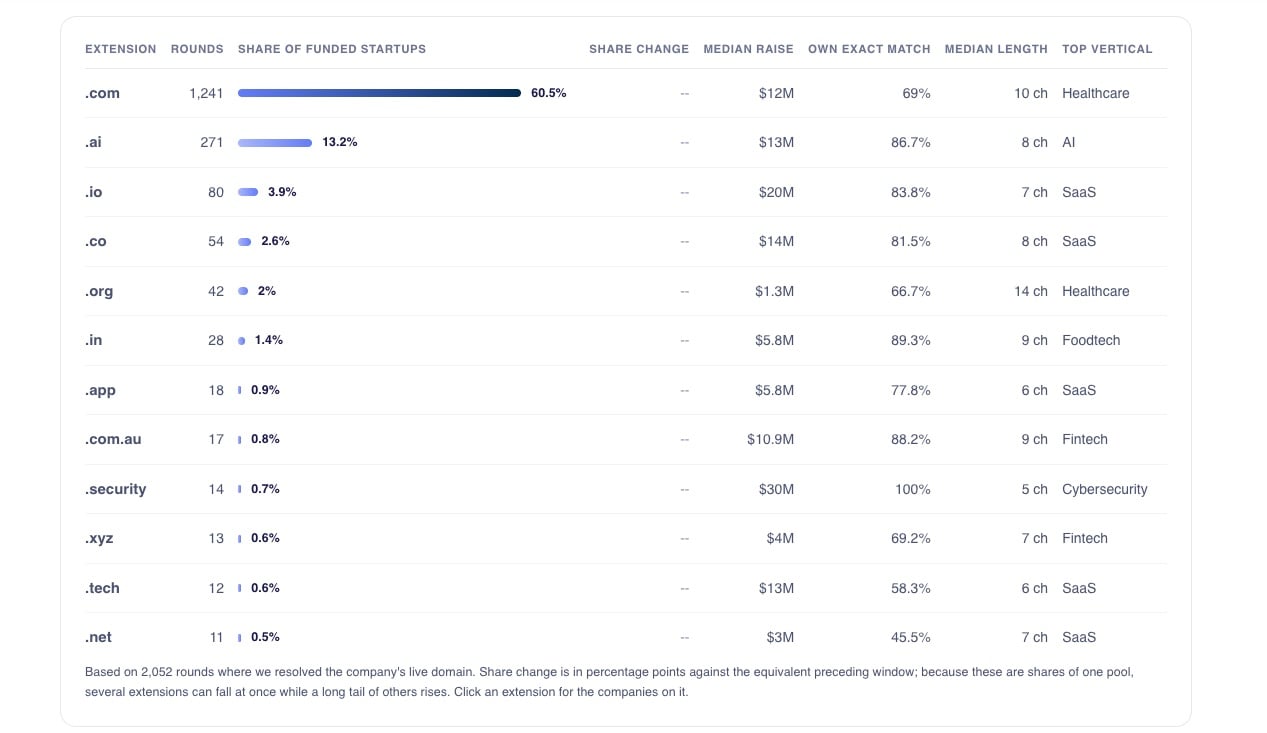
.com remains the dominant extension among funded startups, representing roughly 60% of the companies in our current dataset.
But that headline number hides a much more interesting story.
.ai has established itself as the clear second choice, representing roughly 13% of funded companies overall.
And extension adoption isn’t uniform across industries.
Among AI startups in our dataset, .ai and .com are now nearly even. In industries such as biotech, .com remains overwhelmingly dominant. Cybersecurity companies show a much broader distribution across .com, .io, .ai and other extensions.
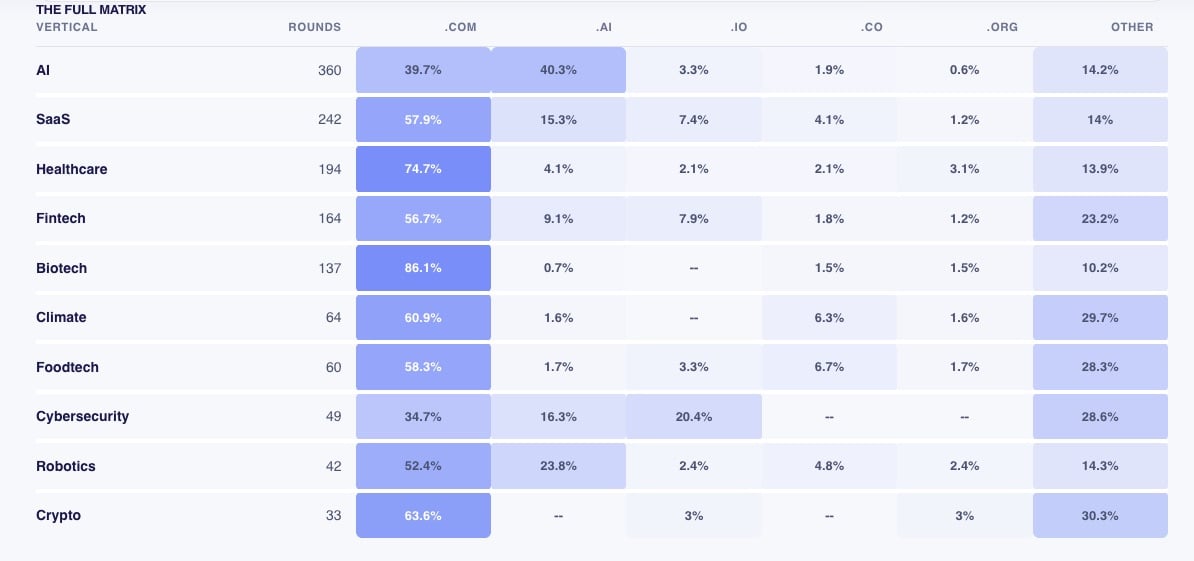
This suggests that domain-extension preferences are increasingly connected to the ecosystem in which a startup operates.
Domain Choices Change as Companies Grow
One of the clearest patterns in the data appears when we look at funding stage.
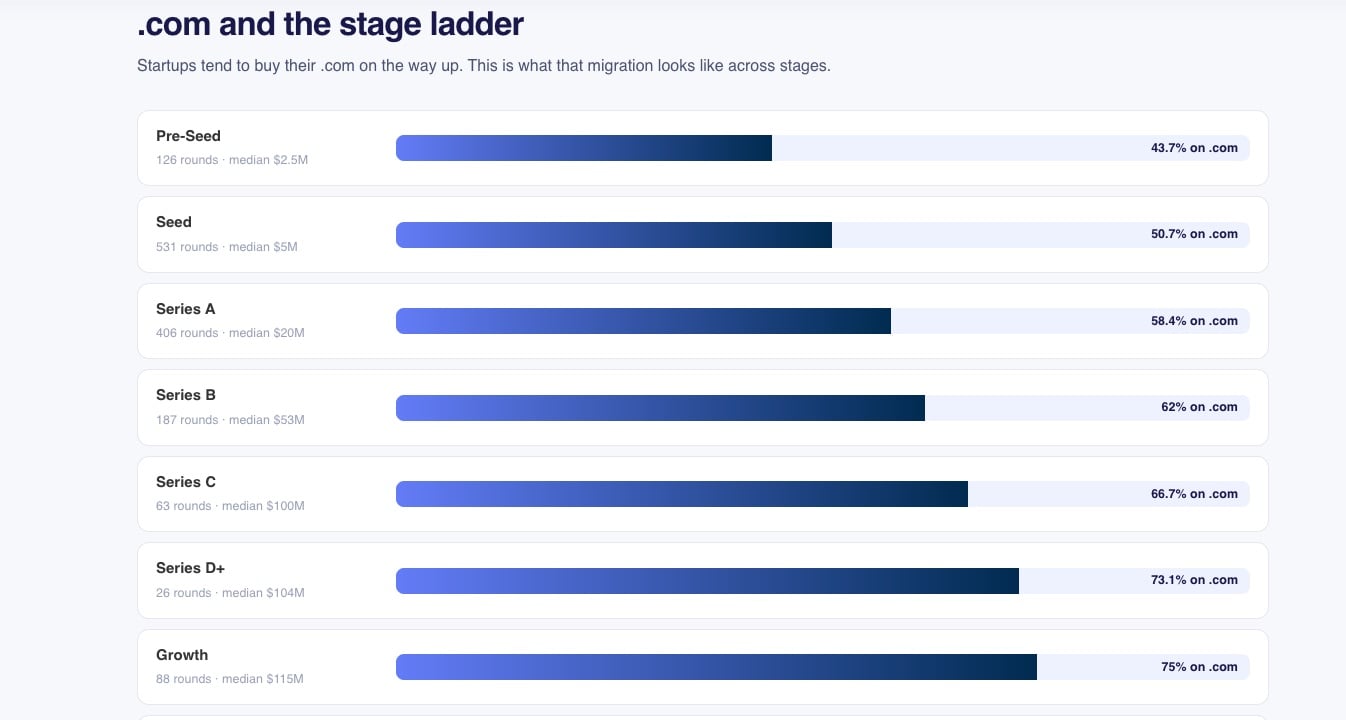
Among Pre-Seed companies, approximately 43% use .com.
That percentage rises steadily as companies progress through later funding stages, reaching more than 73% among Series D+ companies in the current dataset.
There are several possible explanations.
Companies that begin on alternative extensions may acquire their .com as they grow. Companies with stronger capitalization may be more willing to invest in premium domains. And companies that already own strong domains may differ in other ways from the broader startup population.
The data doesn’t establish causation.
But the relationship between company maturity and .com adoption is difficult to ignore.
What Are Funded Startups Naming Themselves?
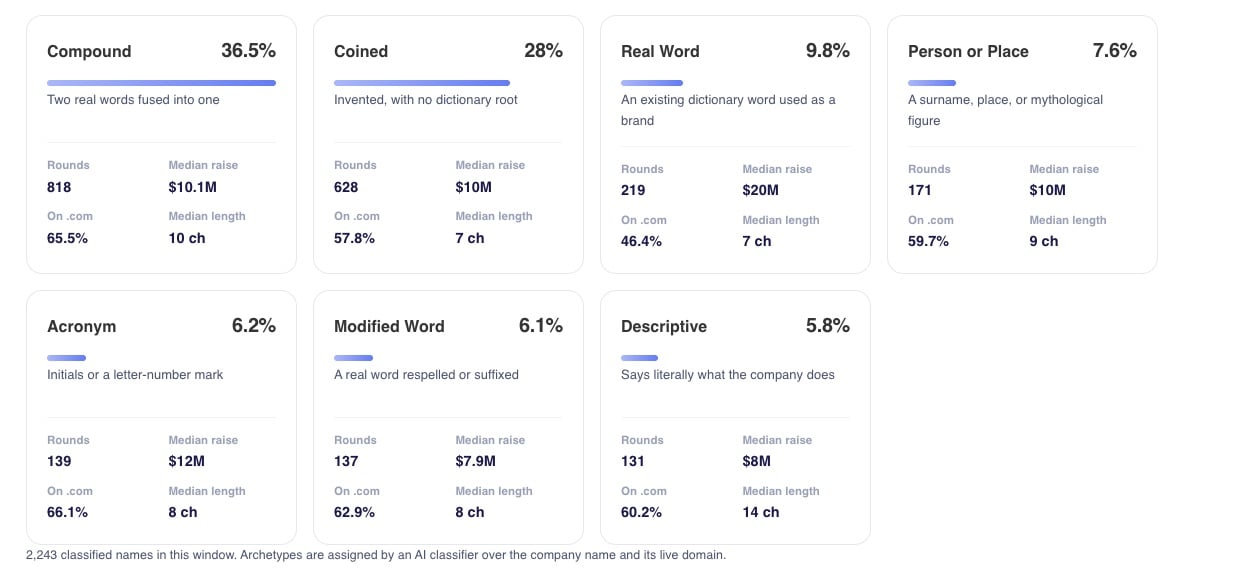
The tracker also classifies startup names into several naming archetypes.
Compound names are the most common, followed by coined names.
But when we look at median funding amounts, another category stands out.
Startups using real-word names have a median funding round of approximately $20.9 million in the current dataset, compared with $10.1 million for compound names, $10 million for coined names, and $8 million for descriptive names.
Again, this doesn’t mean choosing a real-word name causes a company to raise more money.
Later-stage companies may be more likely to own these names. Well-capitalized founders may have greater access to premium naming assets. Industry composition may also influence the numbers.
But these are exactly the kinds of relationships we hope the tracker will make easier to investigate.
Funded Startup Names Are Surprisingly Compact
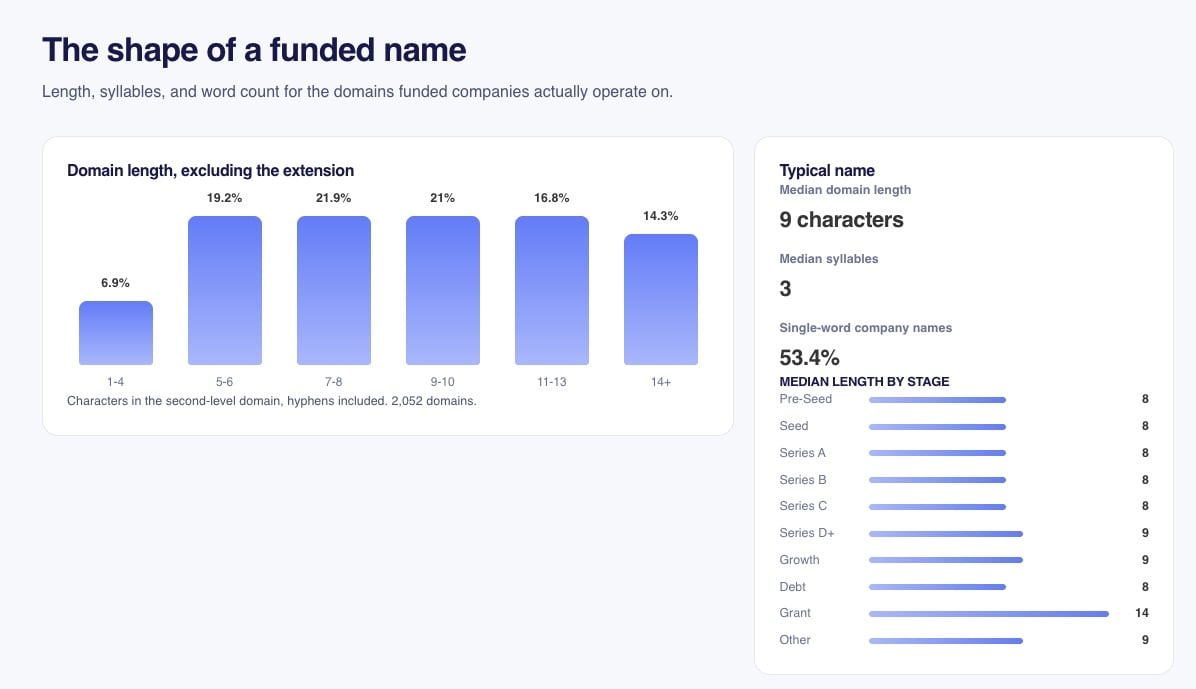
Across the dataset, the median funded startup domain is only nine characters long.
The median company name has three syllables, and more than half of the companies use a single-word name.
Perhaps more interestingly, median domain length changes very little across funding stages.
Startups don’t necessarily need the shortest possible name. But the data suggests that even as naming styles diversify, funded companies continue to gravitate toward relatively compact brands.
One in Four Funded Startups Doesn’t Own Its Exact-Match Domain
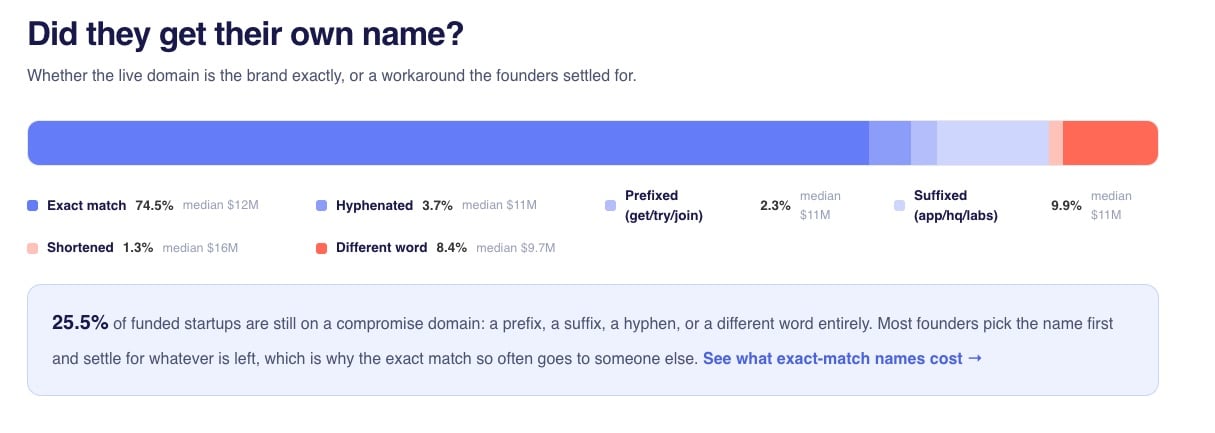
Another opportunity becomes visible when looking at exact-match ownership.
Approximately 25% of funded startups in the dataset do not currently operate on the exact-match domain for their brand.
Instead, they may use prefixes, suffixes, abbreviations, alternative extensions, or other variations.
For domain investors and sellers, this is an important part of understanding demand.
A company raising capital isn’t simply another funding announcement. It may also represent a company entering a new stage where brand and domain decisions become increasingly important.
Building a Better Picture of Domain Demand
Historically, much of the domain industry’s market intelligence has started with the asset.
Which domains are selling? What keywords are performing? Which extensions are gaining value?
Those questions remain important.
But there is another way to study the market: start with the companies creating the demand.
Which industries are attracting capital? What naming patterns are emerging inside those industries? Which extensions are founders choosing? How do those choices evolve as companies mature?
No individual data point answers those questions.
Thousands of data points can begin to.
That’s what we’re building the Startup Funding Tracker to explore.
The tracker is free. It updates as new funding rounds are announced, so the underlying dataset and the trends derived from it will continue to evolve.