 Get Started


 Login
Login
 (877) 355-3585
 Chat
Chat Email
Email Help Desk


Domain investing is often misunderstood. Some people think it’s all about gut instinct—buying names that “sound good” and hoping they sell. Others take the scattershot approach, acquiring thousands of domains and crossing their fingers that a few will pay off. But the investors who consistently win don’t rely on hope. They treat domain investing like a business—analyzing data, tracking performance, and making smart, calculated decisions.
If your approach to domain investing feels like a guessing game, it’s time to change that. The difference between a struggling investor and a profitable one isn’t luck—it’s strategy.
Why Data Matters—But So Does Judgment
Many domain investors fall in love with their portfolio and believe certain names “feel” valuable. But emotional attachment doesn’t pay renewal fees. The best investors treat domains like an asset class—tracking performance, making calculated purchases, and cutting underperformers.
That being said, domain investing isn’t purely a numbers game either. Unlike stocks, where two shares of Apple are identical, no two domains are alike—which means there’s always an element of subjectivity involved in picking winners. The key is balancing data-driven decision-making with a conscious effort to acquire domains that have real business potential.
Just because names with “crypto” sell well and “fitness” names sell well doesn’t mean CryptoFitness.com is a great investment. The question to ask is: Would a startup actually use this name? A domain needs more than just popular keywords—it has to make sense as a real-world brand.
Winning in domain investing requires a data-first mindset, supported by sound judgment. Let’s break down the metrics that matter most.
The Core Metrics That Drive Profitable Domain Investing
The best investors don’t just track individual sales—they apply data across every stage of domain investing. From identifying acquisition opportunities and determining the right wholesale price to setting an optimal BIN multiple and evaluating overall portfolio performance, they use key metrics to drive smarter decisions. Here are the most important ones:
- P = Purchase price per domain
- R = Annual renewal cost per domain
- S = Average selling price per domain
- STR = Sell-through rate (percentage of domains that sell per year)
- N = Total number of domains in portfolio
- RPD = Revenue Per Domain (aka ASPSTR) = Average Selling Price × Sell-Through Rate (a key metric for expected yearly revenue per domain)
- ERR = Expected Revenue Rate (a metric similar to IRR, measuring overall portfolio performance over time)
How to Calculate Sell-Through Rate (STR)
Sell-Through Rate (STR) is one of the most important metrics in domain investing. It tells you how many of your domains sell within a specific time period. Instead of guessing how well your portfolio is doing, STR helps you understand your actual sales performance.
Basic STR Calculation
The simple formula for STR is:

For example:
- If you own 1000 domains and sold 20 of them in a year, your STR is:
This means 2% of your domains sold in that year.
Annualized STR Calculation (Accounting for Portfolio Age)
If you add and remove domains throughout the year, you need an annualized STR to get an accurate picture. The formula for this is:

This formula adjusts for how long your domains have actually been listed. If your portfolio is 6 months old, your STR needs to be doubled to account for a full year.
Why STR Matters
- A higher STR means your domains are selling well, and your pricing and selection are on point.
- A low STR means you may be overpricing or holding onto low-quality names.
- STR should be compared with industry benchmarks to see if your portfolio is performing well. In general, an STR above 2% is considered very strong, especially if you are selling to retail buyers with a 10X multiple.
RPD: The Most Important Revenue Formula
A high STR is great, but it only tells part of the story. Selling at wholesale prices might push your STR above 5% or even 10%, but that doesn’t necessarily translate to strong revenue or profitability. That’s where RPD (also known as ASPSTR) becomes crucial—it helps measure whether your sales volume and pricing are working together to create meaningful returns.
RPD (or ASPSTR) = Average Selling Price × STR
Think of RPD like rental income on an investment property. If your rental income doesn’t cover your mortgage, you’re losing money. Similarly, if RPD is lower than your renewal costs, your domain portfolio is a liability. At the most basic level, you want your RPD to be above $12 to stay above water. For extensions like .ai or .io, where renewal fees are significantly higher, your RPD needs to be much greater to justify the holding costs.
A high sales price alone doesn’t ensure profitability. A strong STR doesn’t either. You need both.
But renewal costs alone don’t tell the whole story. Acquisition cost matters too. If your RPD is $30, but your average acquisition price is $100, you’ll only break even if you sell within three years. Without factoring in acquisition costs, STR and RPD can paint an incomplete picture of profitability.
ERR: The Domain Investor’s Version of IRR
Investors in traditional asset classes use Internal Rate of Return (IRR) to measure how well an investment performs over time. Expected Revenue Rate (ERR) brings this same concept to domain investing.
Formula for ERR

Where:
- Total Expected Portfolio Revenue = RPD × Number of Domains × Holding Period
- Total Initial Investment + Renewals = Total acquisition costs plus expected renewal fees
- n = Number of years (Holding Period)
ERR gives a long-term profitability view, just like IRR does in venture capital and real estate.
Why ERR Matters
- ERR helps domain investors compare their portfolio returns to passive investments like the S&P 500.
- If ERR is higher than the market average return (8-10%), domain investing is proving to be a strong asset class.
- If ERR is lower than 8%, it might be worth re-evaluating pricing, STR, or acquisition strategy.
Comparing Domain Investing to the S&P 500
Let’s put ERR into perspective by comparing it to a passive investment like the S&P 500, which has historically delivered 8-10% annual returns.
Portfolio EXAMPLE
- Investment: $50,000 (1,000 domains at $50 each)
- STR: 1.4%
- ASP: $2,500
- Annual Renewal Costs: $12,000
- Total Expected Revenue Over 5 Years: $175,000
Using the ERR formula:
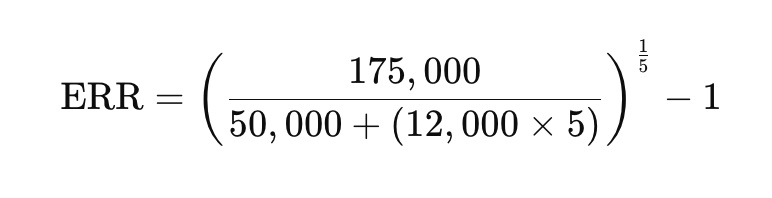
ERR = 9.73%
Key Takeaway
Despite a reasonable STR of 1.4%, this portfolio barely outperforms the S&P 500 (9.73% ERR vs. ~8-10% market return), reinforcing why tracking ERR is essential. Just because a portfolio generates sales and positive cash flow doesn’t mean it’s a superior investment to passive alternatives. To make domain investing a truly attractive strategy, the focus should be on increasing STR or raising ASP to drive stronger returns.
Domain Investing vs. Venture Capital: A Similar Playbook
Domain investing and venture capital operate on the same core principle: asymmetric returns. In VC, investors back multiple startups, knowing that most will fail, some will break even, and a few will deliver outsized returns that drive overall profitability.
Domain investing works the same way. Not every name will sell, but the right ones more than make up for the rest. Like VCs, domain investors must balance risk and reward—some choose to place smaller bets on emerging trends, while others invest in proven assets with lower risk and faster liquidity.
The key to success in both VC and domain investing is portfolio management—knowing when to double down on winners, when to drop underperforming assets, and how to balance risk across a diverse set of investments.
Applying Portfolio Strategy to Domains: Organizing by Performance
Not all domains perform the same. Instead of treating your entire portfolio as a single entity, break it down into buckets based on domain type, and track their performance separately.
Examples of Domain Buckets:
- Made-Up Domains (e.g., Zynko.com, Floxa.com) – Short, catchy, made-up names.
- Keyword Domains (e.g., CryptoBuy.com, AIConsulting.com) – Contain high-value industry keywords.
- One-Word Domains (e.g., Shiny.com, Lilac.com) – Premium dictionary words.
- Geo-Specific Domains (e.g., TexasMortgage.com, LARealEstate.com) – Targeted by location.
- Alternative TLD Domains (e.g., Steam.io, Willow.ai) – Built around emerging non .com extensions.
By tracking RPD and STR per category, you can identify which segments are most profitable and adjust your buying strategy accordingly. A well-balanced portfolio isn’t just about what you acquire—it’s about what you optimize.
Final Thoughts
The best domain investors combine data with judgment. No metric can tell you exactly which name will sell next, but taking a structured approach ensures that every decision you make improves your odds of success
The key is to track your results, refine your strategy, and invest with purpose—not just hope