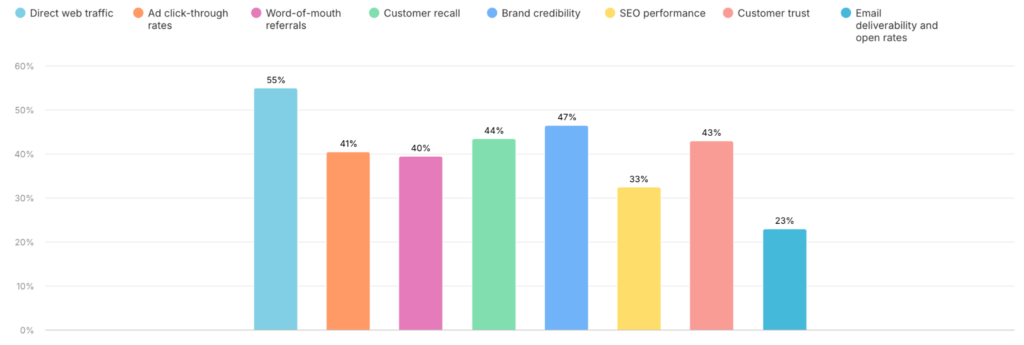
Direct web traffic (according to 55% founders, 66% serial entrepreneurs) and brand credibility (47% founders, 67% serial entrepreneurs) take the biggest hit from a weak domain.
Customer trust and brand recall are also strongly impacted by a weak domain, according to founders and serial entrepreneurs.
Overall, serial entrepreneurs are more likely to consider weak domains as harmful to business outcomes across every impact point. More experienced entrepreneurs consider weak domains more harmful.
Objective: Name and domain play an important role in branding and marketing, impacting a range of metrics. Companies with strong brand identities find it easier to attract customers and have a lower CAC, easier to keep customers, leading to stronger CLV, and get more return on investment in marketing activities.
Our recent research found that 68% of business investors say a poor domain will cost brands over 15% of annual revenue, while among founders, two-thirds (67%) think a poor domain costs at least 15% of annual revenue. Notably, for serial entrepreneurs, 84% think a poor domain costs at least 15% of annual revenue.
To better understand the connection between domain name and real business outcomes, we asked a cohort of business founders and a separate group of proven serial entrepreneurs where they believed a weak domain name causes the most damage.
Question:
In your opinion, which of the following business outcomes can suffer as a result of a weak domain name? (Select all that apply)
Direct web traffic
Ad click-through rates
Word-of-mouth referrals
Customer recall
Brand credibility
SEO performance
Customer trust
Email deliverability and open rates
Audience:
Audience One: Founders and C-Suite leaders (e.g., CEO, CFO, COO)
Audience Two: Serial entrepreneurs
Overall Results
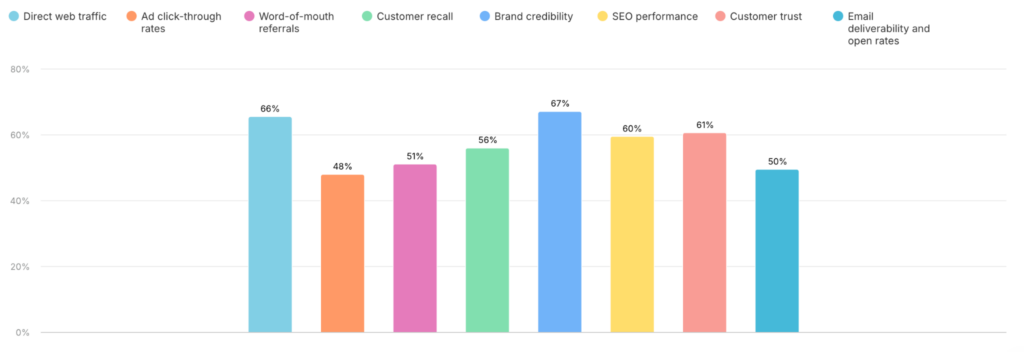
Direct web traffic (55% founders, 66% serial entrepreneurs) and brand credibility (47% founders, 67% serial entrepreneurs) take the biggest hit from a weak domain.
Customer trust and brand recall are also strongly impacted by a weak domain in the estimation of founders and serial entrepreneurs.
Overall, serial entrepreneurs are more likely to consider weak domains as harmful to business outcomes across every impact point. More experienced entrepreneurs consider weak domains more harmful.
Founders
In your opinion, which of the following business outcomes can suffer as a result of a weak domain name?
Serial Entrepreneurs
In your opinion, which of the following business outcomes can suffer as a result of a weak domain name?
Conclusion
This research reveals that the impact extends far beyond brand perception alone, affecting everything from direct traffic and customer recall to word-of-mouth referrals, advertising performance, and overall brand credibility.
Perhaps more significantly, serial entrepreneurs are more likely to consider weak domains as harmful to business outcomes across every impact point. The result is clear: experienced entrepreneurs know the value of a domain, and founders early in their careers are more likely to underestimate the power of a strong domain.
Together, these findings paint a clear picture: a domain name is not simply a digital address, but a business asset that influences customer acquisition, growth, and long-term enterprise value.
If you’re interested in digging deeper into our findings, or asking your own questions on domain choice and branding topics, contact thom@atomradar.com to learn more.
Thom Davies is a researcher at AtomRadar and content strategist for Atom.com. His background in quantitative and qualitative analysis is the foundation for data-led brand strategy.
Business investors, including VCs and private equity investors, are key stakeholders in early-stage startups, and demonstrating strength and ambition to...
Key takeaways: Objective: For both immediate impact and long-term memorability, single-English word domains have long been considered a benchmark for...