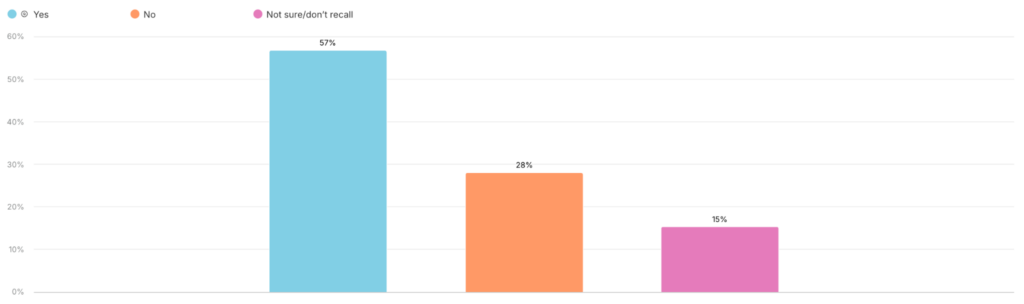
57% of consumers have failed to find a brand online by following the exact-match, .com template.
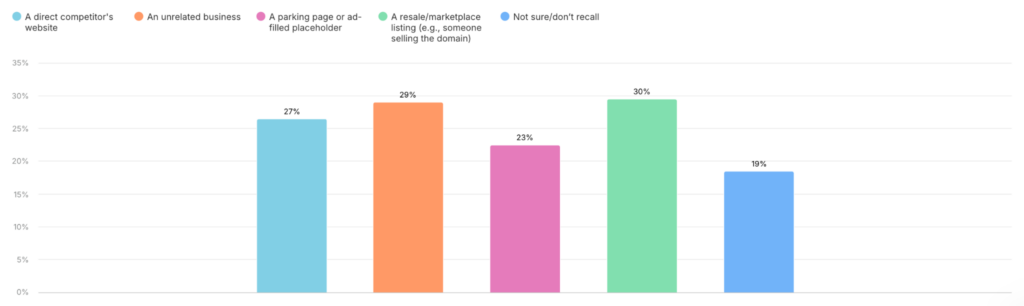
Of these consumers, 27% landed on a direct competitor’s website (15% of consumers overall).
30% found the domain for sale; 27% found an unrelated business.
Objective: In the digital world, consumers are familiar with certain patterns and the exact-match domain plus .com template is the gold-standard for finding brands online. We sought to understand how often consumers encounter the wrong destination when using the common “[brand].com” navigation pattern, and to identify where they end up when an exact-match .com domain does not lead to the intended brand. This research explores the potential for domains to divert consumer traffic to competitors, unrelated businesses, and other destinations, and can guide new businesses in shortlisting, validating, and selecting the strongest possible domain to minimize traffic leak.
Question:
Question one: Have you ever typed a brand’s name followed by “.com,” expecting to reach that brand, and instead landed on a competitor’s site or a parking/ad page?
Yes
No
Not sure / can’t recall
Question two: When “[brand].com” didn’t take you to the brand you expected, where did you end up? (Select all that apply)
A direct competitor’s website
An unrelated business
A parking page or ad-filled placeholder
A resale/marketplace listing (e.g., someone selling the domain)
Not sure/don’t recall
Audience:
A representative panel of American consumers aged 18 – 64.
Overall Results
57% of consumers have failed to find a brand online by following the exact-match, .com template.
Of these consumers, 27% landed on a direct competitor’s website
30% found the domain for sale; 27% found an unrelated business
Have you ever typed a brand’s name followed by “.com,” expecting to reach that brand, and instead landed on a competitor’s site or a parking/ad page?
When “[brand].com” didn’t take you to the brand you expected, where did you end up?
Conclusion
Our research found that exact-match .com domains have a meaningful impact on where consumers end up online. More than half (57%) of consumers have experienced a failed “[brand].com” search, and 15% of consumers overall say they landed on a direct competitor’s website as a result. With others encountering unrelated businesses, parked domains, or domains for sale, the findings highlight how an unclear or unavailable domain can create opportunities for competitors to capture intended brand traffic. While not every new business can acquire an exact-match .com from the outset, it should be a consideration, and avoiding any overlap with active businesses operating at the .com domain could be crucial for clarity.
If you’re interested in digging deeper into our findings, or asking your own questions on domain choice and branding topics, contact thom@atomradar.com to learn more.
Business investors, including VCs and private equity investors, are key stakeholders in early-stage startups, and demonstrating strength and ambition to...
Key takeaways: Objective: For both immediate impact and long-term memorability, single-English word domains have long been considered a benchmark for...