Summary:Inthis comprehensive, data-driven guide to branding we presented 12 questions to a representative audience of American consumers. We gained key insights into brand tone, branding trends, and color psychology as well as how consumers define and value brand mission and authenticity in 2024.
Key takeaways:
Most influential brand tones: warm and inviting; historied and trusted.
Consumers don’t connect with cheeky and irreverent brands.
18 – 24s are twice as likely to consider a social, ethical or environmental mission ‘very important’ compared to 55 – 64s.
Red is predominantly perceived as exciting; blue as calm.
Branding featuring AI is the least impactful trend, according to consumers, and the most overused.
36% would not be likely to purchase from a brand that doesn’t align with their values.
Genuine engagement with customers is seen as the strongest hallmark of an authentic brand.
Mission and values rank higher than product characteristics for 18 – 24s in building a relationship with a brand.
Objective: To help new and rebranding businesses make informed decisions about their brand identity.
Audience: A representative panel of American consumers aged 18 – 64.
Our Results
Brand Tone
Brand tone provides the voice of your business and plays a significant role in the perception of your products, services and identity. Brand tone should be consistent across email marketing, product information, social media and website copy — so choosing the right one for your audience matters.
Most influential brand tones:
Warm and inviting (61% call it extremely or very influential)
Historied and trusted (60% call it extremely or very influential)
Modern and innovative (56% call it extremely or very influential)
Least influential brand tones:
Cheeky and irreverent (26% say it’s not at all influential)
Emotionally impactful (21% say it’s not influential, or only slightly influential)
Fun and playful (19% say it’s not influential, or only slightly influential)
How influential do you find the following brand tones when building a relationship with a brand?
Brand Mission
Brand mission gives your brand a deeper purpose, and can connect to a compelling story. Our previous research has shown that three-quarters of Millennials will pay more for mission-based brands while it’s less influential on older consumers.
63% say it’s important for brands to have a social, ethical or environmental mission.
18 – 24s are twice as likely to consider brand mission ‘very important’ compared to 55 – 64s.
Men are twice as likely to consider it unimportant for a brand to have a mission: 15% of men vs. 7% of women chose ‘unimportant’ or ‘very unimportant’.
How important is it for a brand to have a clearly articulated social, ethical or environmental mission?
Because of deep-rooted cultural, or even evolutionary, associations with colors, your brand colors impact how you’re perceived. While it’s far from universal, you can use color psychology in your brand colors and logo design to reinforce your brand identity.
Primary colors (red, blue, and yellow) have stronger associations than secondary colors.
Red is seen as exciting
Blue is calm
Yellow is perceived as friendly.
The most trustworthy color is blue.
The color most associated with wisdom is green.
Which characteristics do you associate with the following colors? Choose up to two.
Which characteristics do you associate with the following colors? Choose up to two.
Branding Trends
From nostalgia to minimalist logo redesigns, understanding the popularity of trends among customers ensures you stay relevant and promote your brand in the most impactful way.
Rank the following branding trends from most to least impactful for a brand you’re considering a purchase with.
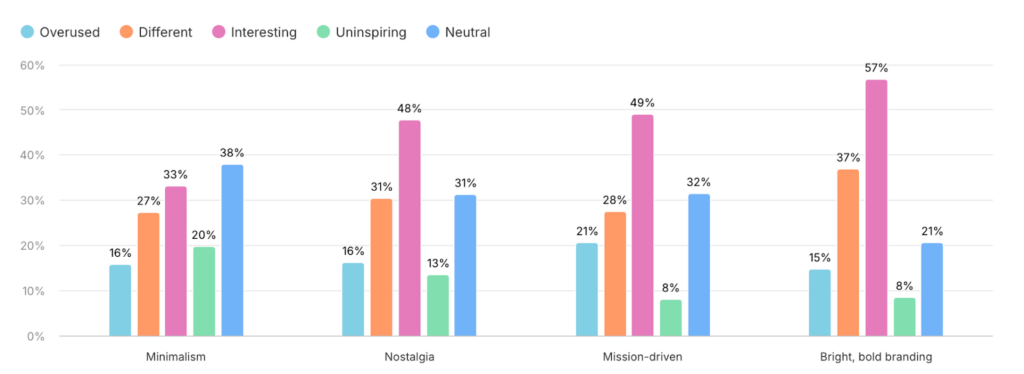
How would you describe each of the following branding trends? Pick up to two descriptors for each.
Branding featuring AI is the most overused.
Bright, bold branding is most interesting.
Humanized branding (e.g., hand-written fonts and illustration) is seen as the most different.
How would you describe each of the following branding trends? Pick up to two descriptors for each.
How often have you come across the following branding trends within the last 3 months?
How often have you come across the following branding trends within the last 3 months?
A full breakdown of our research on the biggest branding trends in 2025 can be found here.
Building Authenticity
Previous research has found that brand authenticity is important to 98% of consumers, and increasingly hard to find the AI age, as half of consumers say that the use of generative AI harms brand authenticity. Authenticity can set you apart from competitors and be the foundation of a loyal customer base.
Communication with customers is the biggest opportunity to demonstrate authenticity: genuine engagement with customers is the most important factor for 33% of consumers.
Transparency about practices and processes is a close second.
Commitment to social responsibility is the least important factor in building authenticity — important to just 13% of consumers.
What aspect of a brand do you think most contributes to its authenticity?
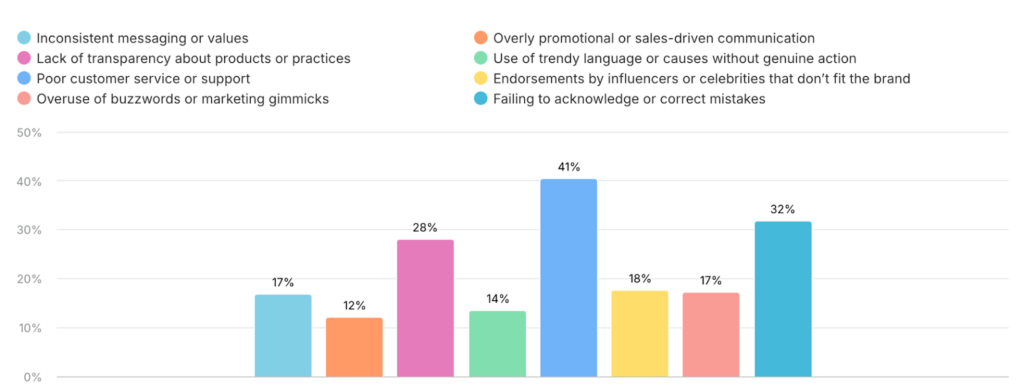
Which of the following aspects are most significant in making a brand feel inauthentic to you? Choose up to two.
Poor customer service and failing to address your mistakes have the biggest negative impact on authenticity.
Building Strong Customer Relationships
A strong relationship with your audience builds loyal customers who choose you over the competition. It also leads to peer-to-peer recommendations and organic growth in brand awareness.
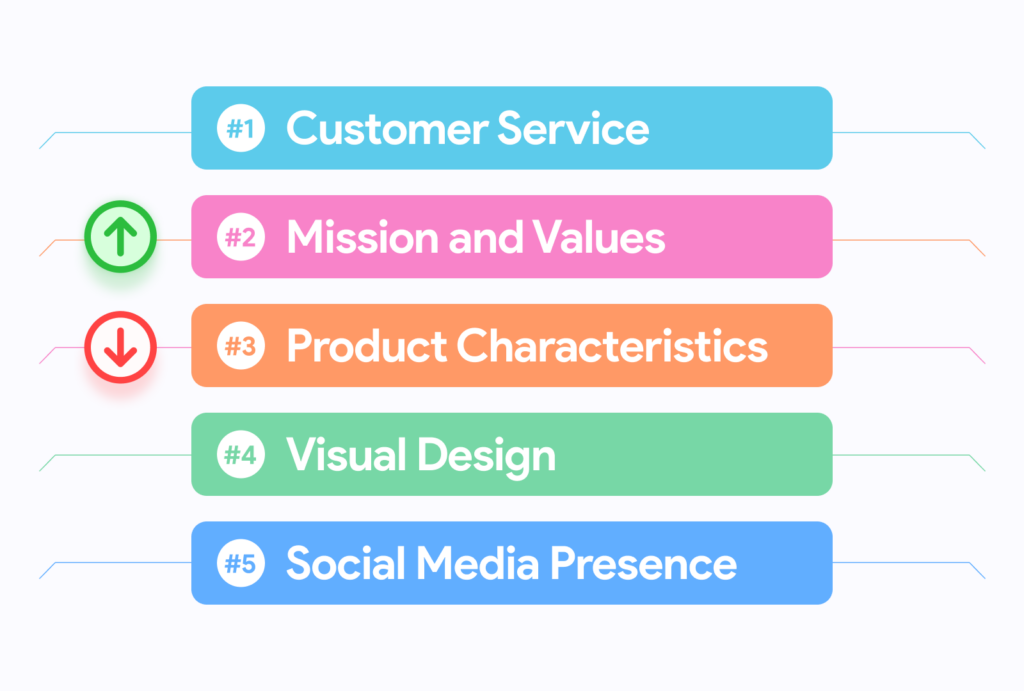
Customer service is the most important for all age groups.
Younger consumers consider social media presence more important than older consumers.
Mission and values rank higher than product characteristics for 18 – 24s.
Rank the following in order of how important they are in building a relationship with a brand.
All consumers:
18 – 24s
Connecting with Customers’ Lifestyle and Values
Connecting your brand with the lifestyle and values of your customers deepens consumer-brand relationships beyond the transactional.
71% of consumers say that it’s important for a brand to demonstrate an understanding of their lifestyle and values.
44% of 18 – 24s vs 30% of 55 – 64s say it’s very important.
36% are not likely to purchase from a brand that doesn’t align with their values.
How important is it that a brand demonstrates an understanding of your lifestyle and values?
How likely are you to buy a product that you want from a brand that does not align with your values?
Trust and Search Engine Optimization
Dominating search results ensures your customers can find you — it also impacts how they see you. Half of shoppers use Google to find new products, and high-ranking brands are perceived as more trustworthy by consumers.
80% of people say they trust brands more when they’re in the top hits for online searches.
89% of younger consumers trust high search engine results page (SERP) brands, vs 71% of 55 – 64s.
How much more do you trust a brand that shows up in the first results when searching for products or information online?
From building authenticity to communicating with your audience, your brand choices should be driven by your audience’s expectations and how you want to be perceived.
Thanks to the connectivity of the internet and the introduction of AI tools, it has never been easier to start a business. With this, our markets are more competitive than ever and in this landscape, a powerful brand that connects with your audience is key to standing out. A strong business name can be the foundation for your brand, so explore our core research on choosing a name next.
If you’re interested in digging deeper into our findings, or asking your own questions on consumer, branding and worklife topics, contact thom@atomradar.com to learn more.
Want personalized insights?
Run your own brand surveys and more with AtomRadar. Our data can power your brand development.
Grant Polachek is Chief Growth Officer at Atom.com. With 15 years experience in marketing, he has run market research projects for brands like Dell, Hilton, and Alibaba. Grant has expertise in a range of topics including domain names, naming and digital marketing.
Domains can play an important role in marketing performance, potentially influencing metrics such as click-through rates, conversion rates, and cost-per-click....